By: Cole Entress
Over the past year, as Springpoint has worked with schools to increase the amount and improve the quality of student thinking in high school classrooms, we’ve discovered that changing how teachers prepare to teach lessons can be a powerful lever for improving the quality of instruction.
On the surface, this might sound obvious. Of course teachers need to prepare—that’s what lesson planning is, right? Wrong.
This year has hammered home for us that lesson preparation is both distinct from lesson planning and a too-frequently overlooked component of instructional improvement. Lesson preparation is about identifying what’s most essential in a planned task, and how to keep students’ minds on it from a lesson’s launch until the last bell. Teachers need to prepare lessons even when those lessons come from a green-rated, HQIM curriculum—in fact, when using an externally-created lesson, preparation is frequently even more critical—and yet, teachers often get little to no support in how to prepare to teach lessons effectively.
This is problematic because, in addition to being a pedagogical move, lesson preparation is also an equity move. We know that not all kids are routinely asked to engage in the productive struggle needed to produce cognitively independent learners—a phenomenon that Zaretta Hammond has called cognitive redlining. If teachers are to actively disrupt inequity by keeping students in historically marginalized groups “in the game” of productive struggle, then advance preparation becomes doubly important.
So, in this post, we’re sharing some of our early findings about lesson preparation in the hopes of inviting a conversation about this crucial ingredient of good teaching. Specifically, we have determined that:
- Lesson preparation is all about focus.
- Lesson preparation can be enhanced by tools.
- Lesson preparation takes time (but not an unmanageable amount of time!).
Lesson preparation is all about focus
Imagine a first grader brings you a writing sample that looks like this: “The doggy runed away he was skard” What feedback would you give?
There are, of course, lots of options. The sentence is a run-on, and it is improperly punctuated. There are several spelling errors. A past tense verb is formed incorrectly and in defiance of the general rules of phonics. It should be noted that there are also things to praise here: this is an attempt at a “two-scoop sentence” that moves beyond the extremely short sentence forms (“I ate apples.” or even “I ate.” ) that struggling first graders often favor. None of these pieces of feedback is wrong, necessarily. But which ones allow the teacher to maintain appropriate rigor? And how should that feedback be phrased so that the teacher can keep the writer engaged in productive struggle instead of accidentally removing the cognitive lift?
These are tricky questions, ones that represent the artful, adaptive work of teaching, and they aren’t the sorts of questions teachers should be figuring out in the moment. Virtually nobody has the bandwidth for that, especially not teachers, who are thinking about student work while also handling bathroom requests and watching the clock AND reading notes from the main office AND checking in on students who seem to have something bigger on their minds.
Instead, teachers should be figuring this sort of thing out ahead of time. Through lesson preparation, teachers develop a clear picture of what the day’s task demands of students, what excellent work will look like, and how they can prompt students to keep thinking about the day’s key ideas. Teachers should use the relative calm of their “off-stage” time to make it as easy as possible to focus, with students, on what matters most. Then, when the lesson goes live, teachers will have their priorities in place and can make principled instructional decisions rather than reactive (and often rigor-reducing) ones.
Lesson preparation can be enhanced by tools
If the goal of lesson preparation is to help teachers keep students focused on rigorous work with less improvisational effort, then lesson preparation needs to result in a product that lowers the working memory demands of facilitation. A flexible, consistently used tool is key here—such a tool allows teachers to externalize all that powerful pre-thinking about questions and task demands, and then reference it responsively during the lesson.
This is something that we did not, at first, appreciate sufficiently. Last fall, we shared a perfectly adequate note-catcher for lesson preparation, but it wasn’t something that teachers could easily refer to during lessons. Thus, it ended up feeling like just “one more thing” teachers were being asked to do, rather than an investment that paid real dividends during facilitation (Oops!). We’ve been on the hunt for something better.
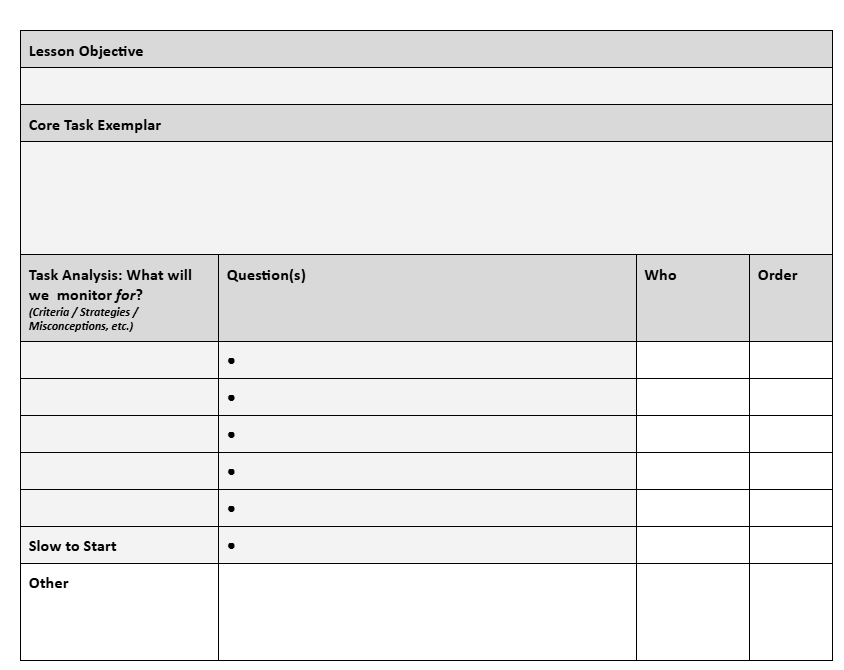
Recently, we’ve been particularly inspired by the book 5 Practices for Orchestrating Productive Mathematics Discussions, which includes a lesson preparation template that sets teachers up to anticipate how students might approach the coming lesson and helps them think through a reaction. It even includes a place where teachers might note which students take each approach, so that the teacher can organize a debrief discussion for later in class.
We’ve created a less mathematics-specific version of this template (See Figure 1, below) that we will be trying out with teachers in the fall. We’re especially eager to dive into the column called “task analysis,” because it invites teachers to consider their tasks with a new lens. Is this a task I should monitor using specific success criteria (and if so, what are they?). Or, is it a task that invites students to use different strategies? Or, is it a task where student pre-conceptions may interfere with productive reasoning? This is a form of reflection which is different from lesson planning, and different even from creating an exemplar, but it is needed to link strong planning to commensurately strong implementation.
Figure 1: A lesson preparation Template
Lesson preparation takes time, but not an unreasonable amount of time.
One of the biggest “Yeah, but…”s that we encounter when discussing lesson prep is that it takes too much time. And, of course, it does take time to create an exemplar, analyze its contours, and think through where students will struggle. However, the time required is manageable, and can be made even more manageable by using a few strategies.
The first, and perhaps the biggest, enabler of this kind of prep is to absolve teachers of the burden of writing curricula from scratch. Creating lessons is inefficient and slow (even with AI), and lessons planned the day before often don’t go well anyway, precisely because the teachers planning them haven’t had time to test the tasks via preparation. Our TLE library is one source of vetted lessons that can free up time for preparation—and one that we, unsurprisingly, really like—but a high-quality curriculum frees up time for preparation, regardless of its source.
Next, preparation can be made more efficient by using a consistent template, like the one in Figure 1. By turning preparation into a standard, professional routine, we can help teachers complete it faster, and more quickly transition from focusing on the form of preparation to its quality. Not incidentally, using a common tool also opens the door to instructional coaching around lesson preparation because it generates a mutually intelligible artifact of teacher thinking. Finally, encourage teachers to time-box this activity. If it’s taking much more than 30 minutes, teachers may be surpassing the point of diminishing marginal returns. They also might be uncovering problems with the underlying lesson—if it takes a teacher 40 minutes to create an exemplar for a lesson task, how are kids supposed to finish the task in one period, let alone debrief it productively as a class afterwards?
All our students deserve teachers who can walk into a lesson with clarity about high expectations, purpose and rigor. Increasingly, we’re seeing that strong preparation is how teachers get there.