By: Natasha Kellett
Seeing innovative schools do things differently is a powerful tool for communities committed to school transformation. It helps folks break free of the mental models we all hold about traditional high schools and widens our aperture for what’s possible for young people. Learning tours can inspire school designers at any stage of their process and spark new ideas about how to make their new vision for the learning experience real. As a recent Springpoint learning tour participant shared, “I think anytime we see a school that is approaching the systems and structures of school in a wildly transformative way it just pushes me to do more and better for our students.”
Springpoint’s guide to planning learning tours shares the key elements of planning an effective experience, such as:
- developing shared learning outcomes,
- planning the visit thoughtfully to illustrate them, and
- bringing back the learnings.
Attending to these pieces helps ensure participants have a shared lens for their visits to host schools and that the rich learning transfers back to their own school’s development.
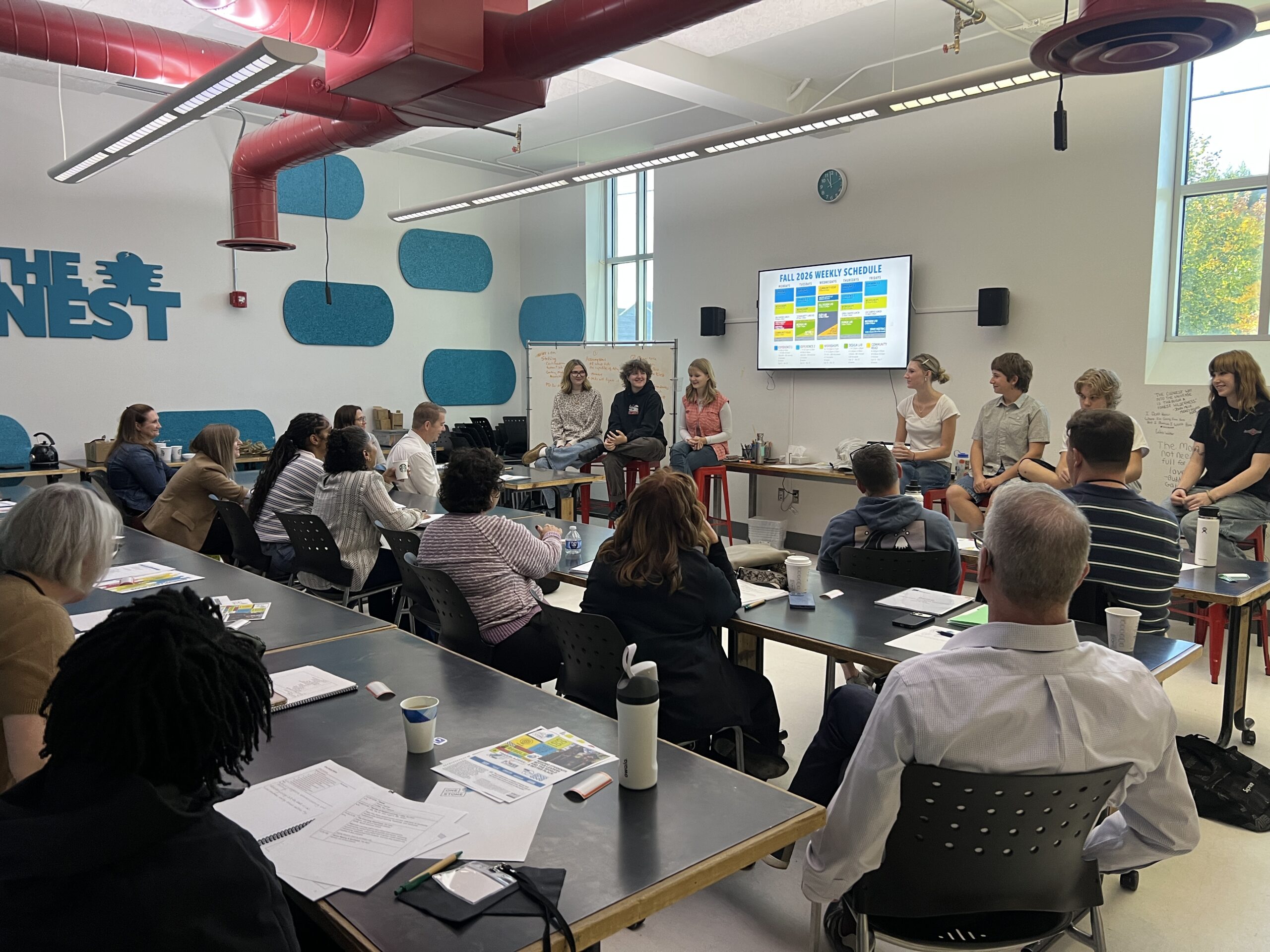
Last month, Springpoint brought together teams of educators, students, and families from schools in Barr Foundation’s Catalyze New Models community for a learning tour to innovative high schools near Boise, Idaho. One Stone High School and Elevate Academies Caldwell and Nampa welcomed forty educators, parents, and students into their communities to explore how they create learning experiences powered by student autonomy.
Our shared learning outcomes focused on the student learning experience through three dimensions of culturally responsive and sustaining practices. We asked, “How do our host schools support a range of students with (1) whole-person development, (2) deep student thinking and (3) student voice and choice?”
At One Stone High School, participants saw this come to life through their highly personalized approach to engaging students in solving real world problems. Students at One Stone are equal partners to adults in their own learning experiences and in the school’s systems and structures. This ranges from choices in the projects they complete within a course to running the school’s board. As a student shared in One Stone’s September newsletter, “Doing the thing is infinitely better than learning about doing the thing.” Seeing the depth of student autonomy and partnership with adults galvanized visitors. As one participant reflected, “The experience advanced our thinking in what can be possible for students when they are given choice. It showed us what is possible with education, even if it looks different than what we know.”
Elevate Academies Caldwell and Nampa demonstrated how academic learning and career and technical education (CTE) can be combined to empower students as professionals and contributors to their community. As one participant reflected, “I had never seen a vocation program that is also student-led. It’s really cool to give kids the trust and belief that they can learn trades and create things with heavy machinery, with support.” Students at Elevate Academies build the skills of Next Step Ready, mastery of academic standards, and mastery of CTE standards so that they graduate ready to take on all of the phases of their careers after high school. As one student shared, “I feel less scared to graduate because I know what to expect in the real world.” Participants surfaced applying learning to the real world as a key takeaway from these visits. One reflected, “We need to adopt a stronger focus on application / applied learning. This would help us strengthen our students’ engagement and voice in the classroom.”
One Stone High School and Elevate Academies take very different approaches to whole-person development, deep student thinking, and voice and choice. However, their shared belief in students and commitment to engaging them in real world learning experiences surfaced several transferable insights for school designers.
(1) Whole person development.
Positive youth development theory tells us that what young people care most about is developing the building blocks of a successful adult life: relationships; cultivating their identity, self-worth, and belonging; discovering meaningful interests; and building mastery of the skills and knowledge required to pursue their interests. Both One Stone High School and Elevate Academies have embraced these as connected parts required to support whole person development for every student in their community. Some examples that surfaced during the learning tour included:
- Elevate Academies’ Next Step Ready (NSR) model, an advisory approach designed with 5 week modules that develop the social, emotional, and durable workplace skills to support students to thrive in life. Participants in the learning tour saw how these skills grow over time, with sixth grade students reflecting on questions like “What did I learn from my first rotation in welding?” and seniors reflecting on questions like “If I were a shop foreman, how would I describe my work?” and “What skills might be different about working in a professional welding shop than our classroom environment? What do I need to work on?”
- Educators at One Stone recognize that different students and different learning experiences might require different containers, whether that container is time, location, modality, etc. They design their year round schedule to provide students with opportunities to take their time with some learning experiences (e.g., a full semester course) and to go deep in a short spurt (e.g., a winter project between semesters).
- At both schools, students in earlier grades are encouraged to try many different types of learning experiences in order to make more informed choices in later grades around their pathway and course selection. For example, at Elevate Academies middle school students rotate through all eight CTE pathways and freshmen and sophomores spend deeper time in four pathways before committing to their pathway for junior and senior year. At One Stone, there are required learning experiences such as their design studio that help students explore different kinds of projects. The impact of these experiences at both schools was profound. A student shared a metaphor that explained it best, “You gotta put your feet in all the different puddles [to figure out what’s for you].”
(2) Deep student thinking
Students at Elevate Academies and One Stone High School develop mastery of the skills and knowledge needed for success after high school by doing real work and connecting their work to their academic learning.
- At Elevate Academies, students draw a range of connections between academic and work-based knowledge and skills in both academic and trade classes. For example, visitors observed a freshman English class using figurative language to describe their most recent construction project as part of a larger unit around storytelling. Students in a tenth grade construction class were observed building dog houses that they would partner with students in the business class to sell as a fundraiser for a local animal shelter. Over time and across courses, students have the opportunity to develop ELA, construction, and business competencies through real tasks that encourage learning by doing and reflecting.
- At One Stone High School, students were observed in several different types of learning experiences and projects that connect the skills and knowledge developed in high school with the real world around them. During observation of “learning experiences” – what we think of as classes in traditional high schools – students were observed debating how two quotes from the Magna Carta and Federalist papers connect to the definition of the rule of law in Idaho today for a history learning experience and breaking down voter statistics to understand the 2024 election in a math learning experience. During their Design Lab projects, students were observed asking questions about what the One Stone community needs to inform their fall project design. One student noted the challenge of what to do with coats and personal belongings in a mobile space and was working on designing a movable storage system. These different experiences helped visitors understand that learning at One Stone connects to the bigger systems and forces shaping society as well as practical actions to make things work better for community members.
(3) Student voice and choice
Student voice and choice emerged as a key inspiration for participants when thinking about what could be brought back to their own schools.
- At both schools, students experienced broad exposure to opportunities in early grades and developed increased autonomy in designing their own schedule over time. As one participant shared, “I used to think that students needed explicit guidance to learn and grow and now I think creating systems where they can comfortably be in command of their own learning could be more beneficial.” Another named increasing student autonomy as a key next step after this learning tour, stating, “It got us thinking about what systems we have in place and how to alter them so that my ownership of learning is placed on students and student leaders.”
- Visiting both schools also unlocked participants’ understanding of the ways traditional schools are designed for adults rather than students. One participant vulnerably shared, “I used to think there were more barriers to increase student voice/choice. Now I think the barriers are impacted by my own fears about relinquishing control.” This unlocked a rich conversation about what needs to be true about adult mindsets and behaviors in order to create environments where students are empowered to take more ownership of their own learning.
Leaving our own buildings can be challenging in so many technical aspects, whether arranging coverage for teachers, finding funding to support learning, or navigating the requirements for bringing students and families on learning tours. But with clear goals and a plan, it can be one of the things that helps inspire the transformation we work towards daily.