Transformative Learning Experience (TLE) Units are purposeful, rigorous, standards-aligned project-based curricula that are deeply informed by culturally responsive pedagogy to center student engagement with learning that is deep and meaningful. Projects demand complex thinking and build critical competencies, with materials that provide entry points for every student.

Give students opportunities to engage with the complex issues that matter to them.
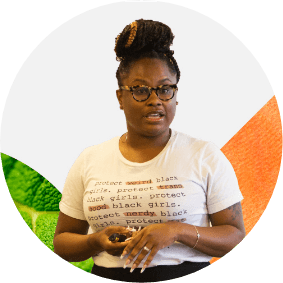
Empower and support teachers with richly detailed implementation guidance.
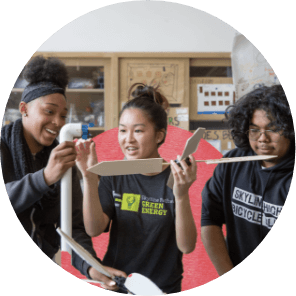
Create classrooms that are exciting, lively, and engaged with the real world.
With full lessons, student handouts, exemplars, and MLL supports, teachers can facilitate great learning, not start from scratch.
With modeled strategies, routines, and implementation supports, teachers build the habits of powerful practice.
Units build academic mastery and success skills like collaboration and critical thinking, all grounded in national standards.
Rubrics support formative feedback, reflection, and evaluation of both content and success skills.
Each unit centers big questions and real-world work that matters to students and their communities.
TLE units span 6-8 weeks (24-30 fifty-minute lessons) and work as stand-alone projects for core or elective classes or full-course building blocks.
TLE Units help realize the promise of project-based learning. Hear from a student.
TLE Units are built to focus on the core skills that will empower student success beyond high school. The units are grounded in culturally responsive and inclusive practices, ensuring students have access to rigor and purpose—the foundation for real equity in the classroom.
Rigor is the demand for critical thinking in the context of open-ended questions that lack simple solutions and pose challenges in a way that piques interest, deepens understanding, and promotes synthesis. Putting rigor at the center of learning means that students, not teachers, do the thinking in the classroom.
Purpose refers to the authenticity and relevance of the learning experience to motivate a student’s interest and promote identity formation. Putting purpose at the center makes learning experiences more culturally responsive and inclusive and connects students with the real world.

Roll over each element to see details:
Challenging Driving Question: The driving question establishes the learning purpose for the project and offers a compelling rationale for undertaking the work.
Real-world Creative Artifact: The creative artifact is a unit’s culminating product that synthesizes student learning and addresses the driving question through a deliverable that has a real purpose.
Community Partnerships: Community partnerships break down the barrier between school and the outside world. By hearing from experts and engaging in field work or simulations, students see the relevance of what they are learning by directly experiencing it in action.
Authentic Public Exhibition: Authentic exhibition is the purposeful display of student work to a specific audience which seeks to effect change or impact that audience.
Written Commentary: Written commentary defends students’ thinking and makes their reasoning visible. It connects ideas to evidence and explicitly links to the unit’s core concepts.
Sustained Inquiry: Sustained inquiry requires students to wrestle with challenges, develop and test ideas, gather evidence, and refine their work.
Critique and Revision: Students must engage in cycles of work and revision during which they incorporate input from teachers, peers and experts to arrive at expertise and solve problems.
Metacognitive Reflection: Metacognitive reflection requires students to think about themselves as learners and consider how to transfer skills they have learned to novel situations.
TLE Units give teachers everything they need to deliver exciting, challenging curriculum.
Read MoreUsers get access to robust curriculum-based PD focused on intellectual preparation and successful implementation.
Read MoreEducators don't need to do this alone. Through our cohort model, teachers will join a community working to transform the student learning experience in their schools.
Read More
Data from a research-validated survey of over 700 students and teachers indicates that students in classrooms that use TLE Units develop in dimensions that are integrally linked to academic success.
100% of teachers agreed:
"This TLE challenged students to do rigorous work."
93% of students agreed:
"I am proud of the project I completed for this TLE."
92% of students agreed:
"I can see how what I learned in this TLE connects to issues in my own life or local community."


Want to learn more or arrange for a professional development experience tailored to the needs of your classroom or school community?