By: Elina Alayeva
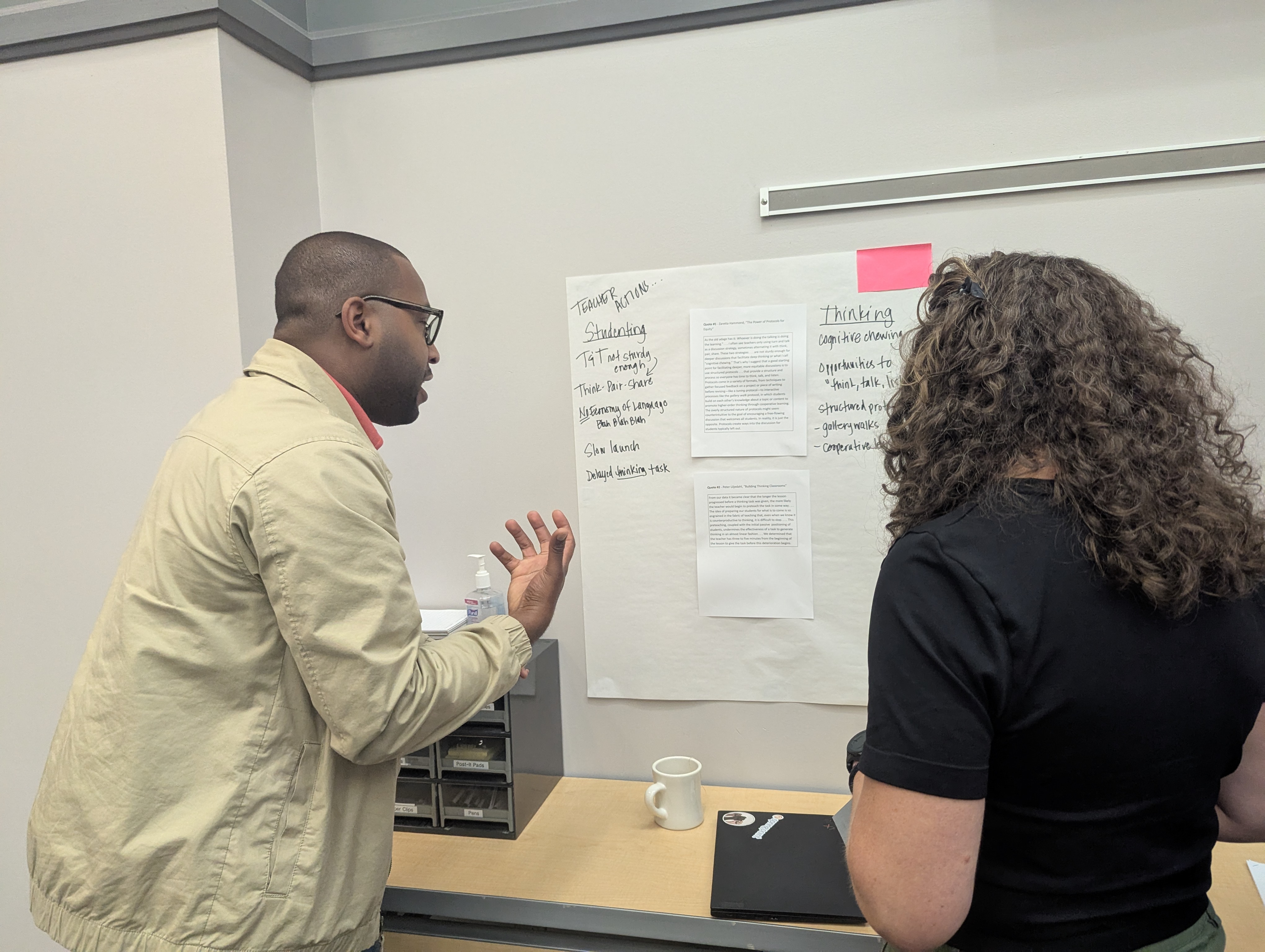
For the past few years, our team has supported schools in implementing rigorous, project-based curricula. The materials were strong, the intention clear, the enthusiasm real. Yet something wasn’t clicking. Teachers often struggled to implement the curriculum in ways that led to deeper learning for students. The cognitive lift we envisioned just wasn’t happening.
That left us wondering: how can we expect teachers to foster cognitive lift if they haven’t seen or felt it themselves?
Designing PD That Mirrors Student Learning
We set out to build a professional learning experience that modeled the very outcomes we want for students. Grounded in research on meaningful adult learning, we focused on three principles: symmetry between adult and student learning, prioritization, and practice.
The result was our summer institute on cognitive lift, designed around one central question: How do we create the conditions where all students are doing the thinking, every day?
Too often, compliant behaviors like quietly copying notes and waiting for the next direction get mistaken for learning. They can look productive but don’t require deep thought. That’s “studenting.” Real thinking is messier and more active, and it places the cognitive heavy lifting where it belongs: on the student.
A Tale of Two Lessons
One of the most powerful parts of the day was led by our teammate Jeff. To explore our central question around cognitive lift, participants stepped into student shoes as he took them through two versions of the same lesson.
- First, the non-exemplar. It was familiar: a slow launch, over-scaffolding, and Jeff himself doing most of the cognitive work. It felt like a classic “sit-and-get” lesson that promotes passive “studenting” It was also PD that mirrored the very classrooms where students are busy but not truly thinking.
- Then, the exemplar. Jeff shifted gears. The launch was quick and purposeful. He gave just enough direction to ensure folks had clarity, then immediately sent participants off to talk, grapple, and use their brains. You could feel the energy in the room instantly shift.
We repeated this rhythm, non-exemplar → exemplar → practice, across the three core phases of a lesson: Launch, Monitor, and Debrief. In the non-exemplars, Jeff carried the cognitive load: a launch that dragged on, monitoring that gave away answers, and a debrief where only a few voices were heard. The exemplar lessons made the contrast clear: a launch that was quick and purposeful, monitoring that pressed on student thinking, a debrief that drew on student work and included every learner.
After feeling the difference, teachers and coaches tried it themselves: scripting a tight launch, drafting questions that advanced student reasoning, and leading debriefs grounded in data. They didn’t just hear about effective practices, they lived them.
Feeling the Lift
Reflections were candid. Many practitioners admitted how challenging it was to spend the day working and thinking deeply, and how much that mirrored what students might feel when asked to move beyond passive “studenting.”
When young people spend most of their academic lives being conditioned to play school, authentic thinking can feel uncomfortable and new. That discomfort isn’t a reason to pull back; it’s a sign that real learning is happening.
Confronting Assumptions
The institute surfaced some hard truths. More than one teacher asked: But my students need more support. Can they really handle being launched straight into the work?
There’s truth there—scaffolds and instructional skill absolutely matter. Teachers need strong questioning techniques, the ability to anticipate stumbling blocks, and ways to support productive struggle. But skill alone isn’t the whole story.
Too often, the deeper barrier is mindset. When we over-scaffold, we end up doing the heavy lifting ourselves. We send the message that students can’t think without us, and in the process, we train them to wait instead of wrestle.
Cognitive lift depends on both: the skill to design for it, and the belief that students are capable of rising to the challenge. Without the second, the first rarely sticks.
Ready to Rewire “Studenting”?
Here are five things you can try tomorrow:
- Audit Your Lessons. Time yourself at the start of your next lesson. How long are you talking versus how long are kids doing and thinking?
- Embrace the quick launch. Get to the purpose and process in two sentences. Say less, sooner, and put the thinking back on students.
- Plan your questions. Anticipate where students might stumble and draft prompts that press on reasoning and figuring out instead of giving away answers.
- Debrief with student work and voice. Use what students produce and say to drive the discussion—make learning visible, and ensure every student participates.
- Reflect with Empathy. After a lesson where students struggled, ask yourself: “Was this productive struggle, or was it confusion brought on by a lack of clarity or content gaps?” Then, ask for feedback: “What did that feel like? What was hard about that? What did you like?”
None of this happens by accident. Cognitive lift requires teachers to do the intellectual heavy lifting before class, so students can do it during class.
When professional learning models these same moves for adults, teachers don’t just understand the strategies, they feel their power. And that’s when cognitive lift becomes possible for students, every day.
This is just the beginning. We’re committed to doing PD that feels as dynamic and thought-provoking as we want our classrooms to be.
Much of this institute was inspired by Building Thinking Classrooms by Peter Liljedahl and Zaretta Hammond’s work on culturally responsive teaching and learning.